Some days, raising bilingual kids feels beautiful.
Some days, it feels like talking to yourself.
If you’re raising a heritage language at home, you probably know what I mean.
There are days when my kids answer me in English after I spend an entire morning speaking Vietnamese. Days when I repeat the same word again and again. Days when I wonder if any of this is actually working.
And then there are moments that remind me exactly why we keep going.
A phone call with grandparents that turns into laughter.
A lullaby from my childhood sung to a baby brother.
A call to “mẹ ơi” sprinkles throughout your day.
Those tiny moments are why this journey matters.
As a Vietnamese mom raising two Vietnamese bilingual children in the Pacific Northwest, I often feel like the bridge between two worlds.
I’m the only Vietnamese speaker in our immediate family. My husband speaks English. Most of our family is in Vietnam. So a lot of the responsibility for passing down our language and culture falls on me.
That can feel heavy sometimes.
But I’ve learned that bilingual parenting isn’t really about creating perfect speakers.
It’s about creating connection.
Language as Love: Strengthening Family Bonds
When I speak Vietnamese with my children, I’m not thinking about vocabulary lists or future language proficiency.
I’m thinking about us: the way I comfort them, the way I tell stories, the way I say “con đang ăn gì vậy?” without even realizing it,… Some feelings just live more naturally in the language we grew up with.
When my daughter tells me “Con thương mẹ,” it hits differently. Not because it’s better than English, but because it’s part of me.
It’s the language that carried my childhood, my family, and my memories.
Sharing that language with my children feels like sharing a piece of home.
Culture in Every Word: Nurturing Identity
People often talk about passing down culture through food, holidays, or traditions.
Those things matter, but language is what makes those experiences come alive: understanding exchanged Tết wishes, the stories being told, the meaning behind the traditions,…
Language allows our kids to participate, not just observe.
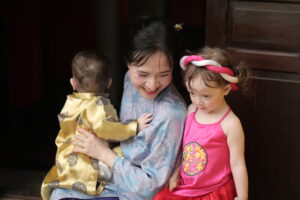
I saw this clearly during a trip back to Vietnam: Watching my daughter chat with relatives, played with cousins, and moved comfortably between her Vietnamese family and her American dad.
She wasn’t standing between two cultures.
She belonged to both.
And that’s exactly what I hope for my children.
Bilingualism Opens Doors
People often mention the academic and career benefits of bilingualism. And yes, those advantages are real. But if I’m honest, that’s not what motivates me on the hard days.
The possibility of a future job isn’t what keeps me speaking Vietnamese when my kids answer in English.
What keeps me going is knowing that language gives them access to people they love.
It gives them stories, traditions, memories, and relationships.
It helps them understand where they come from.
It sustains connection, socially and culturally.
The Hard Days Are Part of the Journey
I won’t pretend bilingual parenting is easy. There are plenty of days when I wonder if I’m doing enough: Days when English feels bigger, easier, and stronger (even for myself); Days when progress is hard to see.
But then my kids say something in Vietnamese that I didn’t teach that week. Or they start singing a Vietnamese song while they play. Or they argue to each other in Vietnamese and carry on a conversation all by themselves.
Those remind me that the seeds are growing. Maybe not as quickly as I hoped. Maybe not in a straight line.
But they’re growing.
Why It’s Worth It
For our family, bilingualism has never been about raising children who speak two languages perfectly. It’s about helping them feel at home in all the parts of who they are:
Vietnamese;
American;
And completely themselves.
So if you’re in the middle of this journey too, wondering whether it’s worth the effort, this is your reminder: the bedtime stories matter; the repeated words matter; the songs, the books, the conversations, the cultural celebrations, they all matter.
Because language is never just language. It’s connection. It’s belonging. It’s love passed from one generation to the next.
And that’s worth every bit of effort.
